 |
- services
- solution
- technology solution
- Sharepoint Portal
- Green Data Center
- Modelling Simulation
- Cloud
- Storage management
- Virtualization
- Network management
- Network security
- industry Solution
- Defense
- Financial
- Healthcare
- telco SERVICES
- Public Sector
- business solution
- Information Security Services
- Service Management
- partner
- bit partner
- TM Platinum Partner
- Cisco Premier Certified Partner
- Microsoft Gold Certified Partner
- Technology Certifications
- partner Highlight

- View More
- partner Highlight
- View More
- customer
- about
- BIT Group

- BIT Synergy

- BIT Ennova

- BIT Services

- BIT Secured Technologies


myren
Connecting researchers and scientists nationwide via high-speed backbone.
The Malaysian Research & Education Network (MYREN) was launched by the Ministry of Energy, Water & Communications, Malaysia in March 2005 to enhance the research capacity and capability of the Malaysian scientific community. The Government of Malaysia long recognized the lack of a research network dedicated to the scientific community in Malaysia. All along, researchers have been using the commodity Internet for their communication needs.
MYREN is an inter-institution network connecting researchers and scientists nationwide via high-speed backbone currently based on the MPLS technology.
The project aims to provide an advanced R&D environment for sophisticated research collaboration and experiments.
In tandem with the objective to uplift the Malaysian Research & Development, MYREN will be linked to other International Research & Education Networks (RENs) such as Trans-Eurasia Information Network 2 (TEIN2), the pan-European research network GÉANT, and other counterparts around the globe in the future.
- MYREN provides a high-speed broadband network for research organizations to link up to each other and carry out collaborative research or applications.
- MYREN is a low-cost alternative to expensive commercial networks.
- MYREN’s high bandwidth capacity allows for data-intensive applications (e.g. bio-modeling and computation) and sharing of resources to be conducted more efficiently e.g. High computing assets can be shared across organizations.
- MYREN provides the experimental platform for researchers to investigate, develop and test new network and internet technologies and applications prior to deployment for commercial use.
- MYREN is linked to other countries’ Research & Education Network (RENs) such that the local research and education communities can be connected, and collaboration can take place on a global scale.
Domestic Network
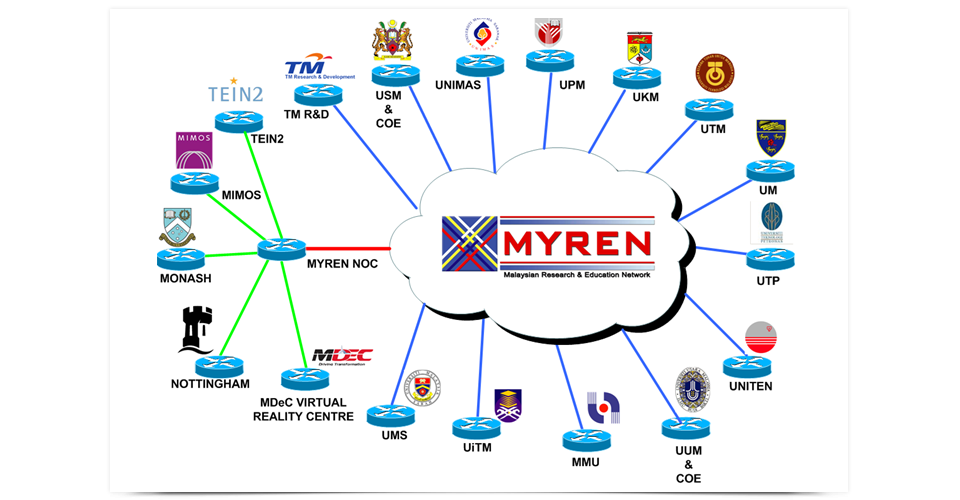
MYREN currently connects fourteen universities and research institutions throughout Malaysia, via a nationwide IP backbone at 45Mbps capacity. The backbone covers eight states in the West and East of Malaysia. With more bandwidth intensive applications and greater user demand, it is envisaged that MYREN will evolve from the current 45Mbps backbone to a larger scale network in the following phase.
Members are connected to MYREN via their respective access link, which can either be a fibre link or microwave link. The access connection varies according to the user’s requirements. MYREN connectivity is centralized at MYREN Network Operation Centre located in Cyberjaya.
The following diagram illustrate the current MYREN network design.
International Link
MYREN is connected to several international research communities in Asia Pacific, Europe and North America, via the Trans-Eurasia Information Network 2 (TEIN2). The connectivity coverage includes China, South Korea, Japan, Thailand, Vietnam, Philippines, Singapore, Indonesia, Australia, Europe and the United States. Researchers connected to MYREN are able to communicate and collaborate with their counterparts overseas over the virtual work space at improved network performance and lower network latency.
MYREN is connected to the Trans-Eurasia Information Network 2 (TEIN2) since April 2006. As of February 2009, TEIN2 was upgraded to TEIN3 from an initial capacity of 45Mbps to 155Mbps. TEIN3 enables MYREN to reach other international research communities in Asia Pacific such as CERNET (China), KOREN (Korea), SINGAREN (Singapore), ThaiREN (Thailand), PREGINET (The Philippines), VINAREN (Vietnam), Institut Teknologi Bandung (Indonesia) as well as the pan-European GEANT2 network.
MYREN2 Objective and Requirement
The main requirement for the MYREN2 network infrastructure is as below,
- Expand accessibility to new and potential members by regionalizing MYREN connectivity
- Support high bandwidth capability scalable up to multi-Gbps at backbone and at least 100Mbps at access layer
- Build upon own infrastructure independent from any service provider (telco managed) for flexibility of offering new advanced service
- Infrastructure that scale to support advanced high performance applications in various fields including bio-informatics, micro-electronics design, telemedicine, grid-computing, chemical informatics, engineering etc
- The infrastructure must support MPLS technology, standard based (interoperable), reliable, scalable and support IPv6 (dual-stack) – unicast and multicast